

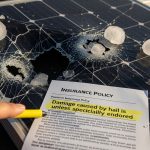


The solar revolution of 2026 is no longer just about saving the planet; it’s about energy independence. With the Federal ITC 30% tax credit reaching its “Safe Harbor” deadline this year, thousands of homeowners are rushing to cover their roofs with photovoltaic (PV) glass. But behind the glossy brochures and the promise of $0 electricity bills, there is a silent, icy predator: Hail.
In the insurance industry, hail is known as the “Solar Killer.” While it accounts for less than 2% of the total number of solar claims, it is responsible for over 50% of the total financial losses in the industry. As we navigate a year of record-breaking atmospheric shifts, understanding the intersection of hardware resilience and insurance policy language is the difference between a protected investment and a $20,000 mistake.
- 1. The 2% vs. 50% Paradox: Why Insurers are Terrified
- 2. Thicker Glass vs. "Hail Stow" Technology
- 3. The "Other Structures" Trap in Your Policy
- 4. Parametric Insurance: The 2026 Industry Shift
- 5. Micro-Cracks and the "Forensic" Requirement
- 6. Your "Insurance-Ready" Solar Checklist
- Verdict: The Roof is Your First Line of Defense
1. The 2% vs. 50% Paradox: Why Insurers are Terrified
Why is a single hailstorm more dangerous to an insurance company than a year of small electrical failures? The answer is Systemic Damage.
When a “standard” 1-inch hailstone hits a traditional shingle roof, it causes cosmetic damage. When that same hailstone hits a solar array, it doesn’t just “dent” the surface; it creates micro-cracks. These microscopic fractures in the silicon cells are invisible to the naked eye but act like a cancer for your energy production. Over the next six months, the heat-cool cycle causes these cracks to expand, leading to “hot spots” that can eventually melt the panel’s backsheet or, in extreme cases, start a roof fire.
In 2026, insurers in “Hail Alley” (Texas, Colorado, Nebraska) have begun raising premiums from 10 cents to as much as 30 cents for every $100 of insured value, specifically to cover this catastrophic risk.
2. Thicker Glass vs. “Hail Stow” Technology
To stay insurable in 2026, your hardware choice is now a factor in your premium. The industry standard has moved from 3.2mm to 4.0mm tempered glass.
-
The 1mm Difference: Testing shows that a move to 4.0mm glass makes a panel nearly 1000x more resistant to the kinetic energy of hail. If you are installing panels this year, check the spec sheet; anything under 3.2mm is considered a “high-risk asset” by modern underwriters.
-
Smart Trackers (Hail Stow): For ground-mounted systems, 2026 has seen the mass adoption of Hail Stow Protocols. Using real-time geospatial intelligence, your smart home hub can receive a National Weather Service alert and automatically tilt your panels to a 60-degree or 75-degree angle. By tilting the panels, you minimize the “direct hit” energy, allowing hailstones to glance off rather than shatter the glass.
3. The “Other Structures” Trap in Your Policy
This is where most homeowners lose their claims. Depending on how your panels are installed, they fall under different sections of your insurance policy:
-
Dwelling Coverage: If your panels are permanently bolted to your roof, they are usually covered under your main dwelling limit. This is ideal, as it typically offers the highest payout and a lower deductible.
-
Other Structures: If your panels are ground-mounted or on a detached garage, they fall under “Other Structures,” which is often capped at only 10% of your home’s value. If you have a $50,000 solar array on a $300,000 home, your 10% cap ($30,000) will leave you $20,000 short after a major storm.
Pro Tip for 2026: Always ask for a “Scheduled Property” endorsement. This locks in the replacement value of the panels regardless of where they are mounted.
4. Parametric Insurance: The 2026 Industry Shift
Because traditional “adjuster-based” claims take too long, 2026 has seen the rise of Parametric Insurance for solar owners.
Unlike standard insurance, which pays based on damage, parametric insurance pays based on an event.
-
Example: If a certified weather station within 5 miles of your home records hailstones larger than 1.5 inches, the policy triggers an automatic payout without needing an inspector to climb on your roof. This allows homeowners to order replacement panels before the inevitable “repair backlog” hits the local market.
5. Micro-Cracks and the “Forensic” Requirement
In 2026, simply showing your insurer a cracked panel isn’t enough. Many carriers now require an Electroluminescence (EL) Test to prove the extent of the damage.
This test is like an X-ray for your solar panels. It can see the micro-cracks that are “invisible” but lethal to the system. If your insurance policy doesn’t explicitly cover “Loss of Production” or “Forensic Testing,” you could be stuck paying $1,500 just to prove to the insurance company that their $20,000 system is broken.
6. Your “Insurance-Ready” Solar Checklist
Before you sign that installation contract in 2026, ensure these four points are covered:
-
Glass Thickness: Is it at least 3.2mm? (Prefer 4.0mm for high-risk zones).
-
Wind Uplift Rating: In hurricane-prone areas, ensure the racking is rated for 150mph+.
-
Deductible Clarity: Do you have a separate “Wind/Hail” deductible? Some policies now carry a 2% to 5% deductible for hail, which could mean paying $6,000 out of pocket on a $300,000 home.
-
Lease vs. Own: Remember, if you lease your panels, the leasing company is usually responsible for the insurance. However, you must confirm they have “Gap Coverage” so you aren’t left paying for electricity while the panels are offline for repairs.
Verdict: The Roof is Your First Line of Defense
In 2026, solar is a “set it and forget it” technology—until the sky turns grey. By choosing high-impact hardware and auditing your “Other Structures” coverage today, you turn a potential catastrophe into a minor inconvenience. Don’t let the “Solar Killer” melt your return on investment.