

In 2026, the relationship between a homeowner and their insurance company is changing from a “pay-and-forget” model to a “partnership in prevention.” Insurers no longer want to just cut you a check after your house burns down; they want to give you the technology to ensure it never happens.
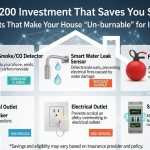
This shift has created a new category of “Insurance-Approved” hardware. By spending a few hundred dollars on specific smart devices, you can unlock premium discounts that pay for the tech in less than 18 months. Here are the 5 gadgets that in 2026 are making homes “un-burnable”—or at least, significantly cheaper to insure.
1. Ting: The Electrical “Firewall” for Your Walls
The leading cause of devastating house fires isn’t a forgotten candle; it’s arcing—hidden electrical faults inside your walls caused by loose wires, pests, or aging infrastructure. Traditional circuit breakers only trip when there is a massive overload, often too late to prevent a fire.
Enter Ting. This tiny sensor plugs into any standard outlet and monitors the “noise” on your home’s electrical grid.
-
The Tech: It uses high-frequency sampling to detect the microscopic signature of an electrical arc.
-
The Insurance Deal: In 2026, giants like State Farm and PURE provide Ting sensors for free to their policyholders.
-
The Payout: Beyond preventing a fire, Ting often includes a $1,000 repair credit to hire an electrician to fix the fault before it ignites. For an insurer, this is a “miracle” device that prevents 80% of electrical fires.
2. Moen Flo: The “Heart” of Water Security
We’ve discussed sensors before, but the Smart Water Shut-off Valve is the heavy hitter of insurance discounts. While a floor sensor tells you there’s a leak, the Moen Flo (or Phyn Plus) acts as the house’s “immune system.”
-
Micro-Leak Technology: These devices perform a nightly “pressure test” on your pipes. It can detect a leak as small as one drop per minute—something that would normally go undetected for years, causing invisible rot and mold.
-
The 15% Discount: Because water damage is the most frequent claim, installing a main-line shut-off valve is often the only way to trigger the maximum “Smart Home” discount (typically 12% to 15% off the total premium).
3. Nest Protect: Beyond the “Beep”
Traditional smoke detectors are “dumb.” If you aren’t home to hear the siren, the house burns. In 2026, Interconnected Smart Smoke/CO Detectors like the Google Nest Protect are mandatory for high-value insurance policies.
-
Split-Spectrum Sensor: It uses two wavelengths of light to detect both fast-flaming fires and slow, smoldering fires.
-
The Automation Loop: When smoke is detected, a smart home hub can automatically turn off the HVAC fan (to stop smoke from spreading), turn on all smart lights to 100% brightness (to help you exit), and unlock all smart locks for first responders.
-
Proof of Life: Insurers love that these devices “self-test” their batteries and sensors 400 times a day, providing a digital log that you haven’t disabled your alarms.
4. Span Smart Panel: The Future of Load Management
The 2026 smart home is heavy on electricity—EV chargers, heat pumps, and solar arrays. This puts massive strain on old electrical panels. The Span Smart Panel replaces your old “fuse box” with a digital brain.
-
Real-Time Load Shedding: If the panel detects a circuit getting dangerously hot, it can automatically “shed” (turn off) non-essential loads like the dishwasher or the EV charger to prevent an overload.
-
Insurance Incentive: Insurers view a Smart Panel as a massive risk reducer for older homes (built before 1990) that are undergoing electrification. It’s the difference between being “uninsurable” and getting a standard rate.
5. Professional Monitoring Kits (SimpliSafe/Ring/ADT)
While “DIY” monitoring is popular, insurance companies still prefer the Professional Monitoring model. Kits from SimpliSafe or Ring that include a 24/7 central station are the “Gold Standard.”
-
The “Certificate of Monitoring”: This is the document your agent needs. It proves that if an alarm goes off, a human being will call the fire or police department within seconds.
-
Cellular Backup: In 2026, burglars use Wi-Fi jammers. Professional kits include cellular and battery backups that stay online even if the power and internet are cut. This “Resilience Rating” is what pushes your discount from a measly 2% to a substantial 10-15%.
How to Claim Your “Housedomo” Discount
Having the tech isn’t enough; you must prove it. To ensure your Housedomo readers get the best deal, advise them to:
-
Request a “Smart Home Audit”: Most agents won’t offer the discount unless you ask for it specifically.
-
Submit the Digital Logs: Download the “Safety Score” or “System Health Report” from your app (Ting or Moen) and email it to your underwriter.
-
Bundle for 20%: Combining a professional security system with a water shut-off valve and electrical monitoring can often “stack” discounts, reaching the 20% cap allowed by law in many states.